

Direct Answer
Yes, it is religiously permissible to perform multiple Umrahs during a single trip according to the majority of scholars (Jumhur). The legal condition is to exit the boundaries of the Haram after each Umrah to the nearest Miqat point (usually Masjid Aisha at Tan’eem) to renew the intention (Niyyah) and enter the state of Ihram. However, spiritual excellence often lies in the quality of the rites rather than their exhausting physical repetition. To preserve your spiritual focus (Khushu) and avoid burnout, it is often recommended to entrust additional Umrahs to students of knowledge via a Badal Umrah service.
1. The Desire to Give Everything (And the Risk of Losing Yourself)
Once standing before the Kaaba, the believer’s heart overflows. You think of your deceased mother, your sick father, or grandparents who never saw these holy sites. The desire to perform an Umrah for each of them is noble; it is immense proof of your filial love and loyalty.
However, chaining rites back-to-back in the heat of Makkah can lead to intense physical exhaustion, reducing your concentration (Khushu) and the quality of your own worship. Islam is a religion of ease and balance, not unbearable hardship. Wanting to do too much to the point of neglecting your obligatory prayers due to fatigue is not the intended goal.
2. The Fiqh Rules: The Precedent of Mother Aisha (RA)
Performing Umrah is an immense act of worship in the sight of Allah. It not only purifies the soul but also expiates past sins, as emphasized by the Prophet ﷺ:
The performance of Umrah is an expiation for the sins committed (between it and the previous one). And the reward of Hajj Mabrur (the one accepted by Allah) is nothing but Paradise.
Al-Boukhari 1773 et Muslim
This quest for purification is legitimate, and the specific permission to multiply Umrahs during the same trip is based on an authentic Hadith reported in Sahih al-Bukhari. During the Farewell Hajj, Aisha (RA) expressed her immense grief at not being able to perform Umrah due to her menstruation. The Prophet ﷺ then ordered her brother, Abdur-Rahman, to take her to Tan’eem (the nearest point outside the Haram) so she could enter into Ihram and perform her Umrah.
While scholars from the four legal schools largely agree on the validity of this practice, some companions and scholars (such as Ibn Taymiyyah) prioritized performing a single, perfect Umrah, arguing that the Prophet ﷺ and his companions did not multiply Umrahs during a single stay in Makkah.
The Procedure for a 2nd Umrah (and subsequent ones):
- Finish the First Umrah: Complete the Tawaf, Sa’i, and hair cutting (Taqsir/Halq).
- Exit to the Miqat: Travel to Masjid Aisha (Tan’eem) by taxi or bus.
- Renew the Intention: Perform Ghusl (if possible), put on Ihram, and formulate the Niyyah.
- Return to the Haram: Go back to the Sacred Mosque to perform the full rites.
3. The Tafwiid Solution: Preserve Your Energy, Multiply the Rewards
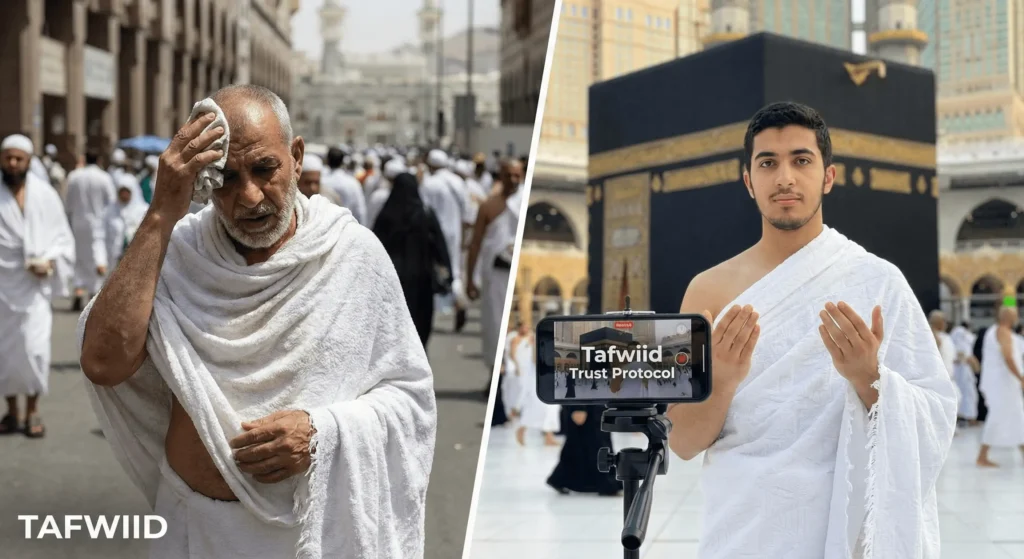
Many pilgrims arrive in Makkah with a list of deceased or sick relatives for whom they wish to perform a substitute Umrah (Badal). While the intention is noble, the physical reality is brutal:
- Physical Exhaustion: The trips to the Miqat and the repetition of Tawaf/Sa’i can impair the focus needed for your own supplications.
- Loss of Spirituality: Fatigue can sometimes transform a profound act of worship into a mechanical routine.
- Health Risks: The intense heat and crowds require prudent energy management.
Instead of rushing between Tan’eem and the Haram at the risk of physical collapse, Tafwiid offers you an ethical and spiritual alternative. Focus on your personal worship, your duas, and your connection with Allah, and entrust the additional Umrahs (Badal) to our qualified executors.
Why is delegating an act of wisdom?
- Spiritual Quality: You save your energy for your obligatory prayers, voluntary Tawaf, and meditation before the Kaaba.
- Execution Excellence: Our Badal services are performed by Students of Knowledge (Talibul Ilm) residing in Makkah. They are accustomed to the climate, master the rites perfectly, and do not face travel constraints.
- Total Serenity: Thanks to our Trust Protocol, you experience the rite by proxy without physical fatigue.
| Criterion | Doing it Yourself (Chaining rites) | Entrusting to Tafwiid (Badal) |
|---|---|---|
| Physical State Impact on Body | Risk of exhaustion / Illness | Rested and focused on Ibadah |
| Quality of Rite Spiritual Focus | Sometimes rushed due to fatigue | Executed with calm and science |
| Proof Verification | Your own memory | Suivi GPS + Video of the rite |
4. The “Triple Reward” Investment
By choosing Tafwiid to relieve your physical burden, you do not lose a reward; you create new ones. It is a “Triple Investment” (Hasanat):
- Reward of the Ritual (Ajr al-Manasik): The Umrah is validated and credited to the soul of the deceased or the sick (Al-Ma’dub).
- Reward of Knowledge (Nusrah al-Ilm): Your fee provides financial dignity to a Student of Knowledge in Makkah, helping them continue their sacred studies.
- Reward of Hope (Nusrah al-Mazlum): True to our ethics, 5% of every booking fee is pledged to charities supporting the oppressed Ummah worldwide.
Conclusion: Prioritize Presence of Heart
Your trip to Makkah is a unique moment between you and your Creator. Do not turn this stay into a race against the clock. By delegating substitute Umrahs to Tafwiid, you ensure that the rite is performed according to the strictest Sunnah, while preserving your energy for your own spiritual elevation.
FREQUENTLY ASKED QUESTIONS (FAQ)
Is it less meritorious to pay someone for Badal Umrah than to do it myself?
No. If doing it yourself comes at the cost of your health or the quality of your prayer, it can be counterproductive. Delegating to a Student of Knowledge (Talibul Ilm) is a double good deed: it is charity (Sadaqah) enabling him to study, and a guarantee of proper execution for the deceased.
Is it mandatory to return to Tan’eem to perform a second Umrah?
Yes. If you are already inside the boundaries of Makkah (Al-Haram), you must go to the “Al-Hill” area (the nearest point is Masjid Aisha/Tan’eem) to formulate your intention and enter into the state of Ihram.
Can I perform one Umrah for two people at the same time?
No. According to the consensus of scholars, an Umrah can only be performed for one person at a time. If you have multiple loved ones to honor, each person requires a separate, complete rite.
How can I trust that the student actually performed the Umrah?
This is the foundation of our Amanah (Trust) promise. Tafwiid is the only service offering real-time GPS tracking during the rites and a personalized video of the student pronouncing your loved one’s name before the Kaaba at the moment of Niyyah.
How much time is needed between two Umrahs?
There is no legally fixed time limit, but the body needs rest. Ibn Taymiyyah suggested that excessive multiplication without rest was not the practice of the Salaf (Pious Predecessors). Tafwiid allows you to respect this natural rhythm without guilt.
Honor their memory today
Don't let distance stop you from fulfilling this noble duty. Book a certified Umrah Badal for your loved ones.
- GPS Tracking
- Video Proof
- 5% Charity